For Australian players looking for up-to-date platforms with fast withdrawals, it’s worth checking out the best new online casino sites Australia 2026 with real money pokies and PayID payouts. This guide breaks down the real terms offered by offshore operators, PayID transaction speeds, and how to tell a reliable platform from a mediocre one. It’s especially useful for anyone who wants to play for real money without waiting weeks for a payout.
Choosing the right deposit and withdrawal option can make or break your online casino experience, so it’s worth reviewing the best online casino payment methods for Aussies in 2026 before you sign up anywhere. This breakdown covers real processing speeds, hidden fees, and the offshore realities that Australian players need to understand. It’s a solid starting point for anyone who wants faster payouts and fewer surprises.
If you’re chasing bigger wins, it helps to know which titles actually deliver, so check out the best paying online pokies in Australia for 2026 before your next session. This guide highlights the machines with the highest RTP and most generous payout potential for Aussie players. It’s a handy reference for anyone who wants more value from every spin.
Before you commit to a new platform, it pays to compare what’s on the table, so start with this guide to the best welcome bonus online casino offers in Australia for 2026. It walks through sign-up promotions, wagering requirements, and the fine print most players overlook. A quick read here can mean the difference between a genuinely useful bonus and a wasted deposit.
For Aussie players who prefer a secure e-wallet over traditional banking, it’s worth exploring the casino sites that accept ecoPayz in Australia for 2026. This roundup covers platforms offering fast deposits, quick withdrawals, and solid bonuses for ecoPayz users. It’s a practical shortcut for anyone who values privacy and speed in their transactions.
Australian players who want to skip the guesswork can head straight to this guide to the best real money online casinos in Australia for 2026. It covers licensed offshore operators, banking options, and the key factors that separate trustworthy sites from risky ones. A useful read for anyone serious about playing for genuine cash rewards.
Prepaid payment options remain a popular choice for players who want to keep their banking details private, so it’s worth reviewing the casino sites that accept Paysafecard in Australia for 2026. This complete guide covers prepaid pokies, deposit limits, and how to cash out winnings from a voucher-based account. A handy resource for anyone who prefers top-up control over linking a card or bank account.
Players who value fast payouts and airtight security often turn to e-wallets, so it’s worth exploring the casino sites that accept Skrill in Australia for 2026. This guide breaks down e-wallet architecture, real payout speeds, and where to find genuine real money pokies. A smart starting point for anyone who wants deposits and withdrawals handled in minutes rather than days.
Finding a casino that supports your preferred banking method can save a lot of frustration later, so it’s worth checking out the casinos that accept MiFinity in Australia for 2026. This guide covers payment options, available pokies, and how withdrawals actually work for Aussie players. A practical read for anyone who wants a smooth, wallet-based casino experience.
Nobody likes waiting days for their winnings, so if speed matters to you, start with this guide to the best fast payout online casino in Australia for 2026. It compares withdrawal times across top platforms and highlights which ones actually pay out within hours. A must-read for players who want their cash without the usual delays.
PayID has quickly become one of the most convenient ways for Aussies to fund their casino accounts, so it’s worth reading this complete guide to new PayID pokies in Australia for 2026. It explains how to make fast, fee-free deposits and which platforms support the method properly. A great starting point for anyone who wants instant transfers without the usual banking headaches.
Getting your winnings quickly is one of the biggest priorities for any online player, so this complete pillar guide to a fast withdrawal casino in Australia for 2026 is well worth a look. It covers payout speeds, verification requirements, and the payment methods that actually deliver on their promises. An essential read for Aussies who don’t want to chase their cash for weeks.
If maximising your returns is the goal, it pays to know which platforms actually deliver, so dig into this definitive guide to the highest payout online casino in Australia for 2026. It breaks down real RTP figures, payout percentages, and how to spot operators that genuinely pay more. A valuable resource for players who want every dollar to work harder.
Not everyone wants to risk a large bankroll straight away, which is why this guide to a low deposit online casino in Australia for 2026 is worth a look. It covers small deposit options, PayID and crypto funding, and everything Aussies need to know before signing up. A smart read for players who want to start small without missing out on the fun.
Safety should always come first when real money is on the line, so it’s worth reviewing this breakdown of the most secure online casino in Australia for 2026. It covers technical safety audits, encryption standards, and the real money protocols that protect players. An essential read for anyone who wants peace of mind alongside their gameplay.
Generating Art with Creative Adversarial Networks (CAN)
Generating Art with Creative Adversarial Networks (CAN)
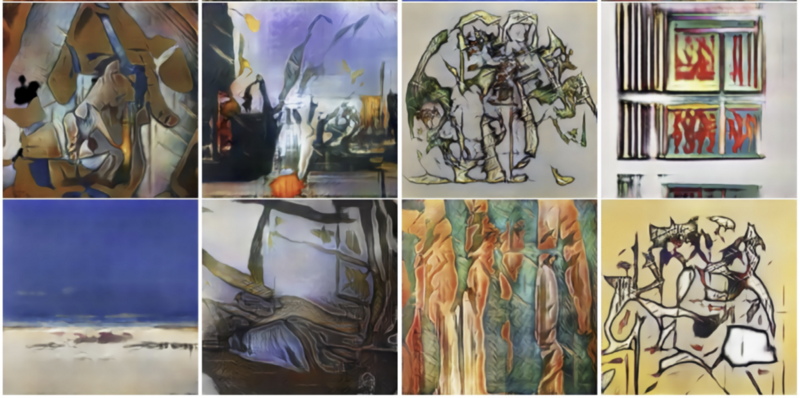
Computationally recreating creativity is a significant step towards Artificial General Intelligence (AGI). Generative Adversarial Networks (GAN) are AI algorithms that can create novel art simulating a given distribution. The system learns about the style of the images it’s exposed to and generates art by deviating from the learned styles and increasing the arousal potential.
The most significant arousing properties for aesthetics are novelty, surprisingness, complexity, ambiguity, and puzzlingness. Creative Adversarial Networks (CAN) modify GAN’s objective and create art by maximizing deviation from established styles while minimizing deviation from art distribution. The model tries to generate art that is novel, but not too novel.
People prefer stimulus with moderate arousal potential — too little is boring and too much may trigger an aversive response. Creative pieces counter well habituation, which is the decreased arousal in response to repetitions of a stimulus. CANs aim to generate art with stylistic ambiguity and high arousal potential without landing it into a negative hedonic range.
A Generative Adversarial Network (GAN) has two sub-networks, a generator, and a discriminator. The discriminator has access to images the model is trained on. The discriminator tries to discriminate between “real” images (from the training set) and “fake” images generated by the generator.
The generator tries to generate images similar to the training set without seeing these images. Its purpose is to create fake images that the discriminator would deem to be from the training set. The generator starts by generating random images and receives a signal from the discriminator telling whether the discriminator finds them real or fake.
At equilibrium, the discriminator can’t tell the difference between the images generated by the generator and the actual images in the training set, hence the generator succeeds in generating images that come from the same distribution as the training set. The generator isn’t creative as it generates images that look like already existing art.
However, in a Creative Adversarial Network (CAN), the generator is designed to receive two signals from the discriminator that act as two contradictory forces to achieve three points: 1) generate novel works, 2) the novel work should not too novel, or far from the distribution, and 3) the generated work should increase the stylistic ambiguity.
The first signal is the discriminator’s classification of “art or not art”. The second signal the generator receives is a signal about how well the discriminator can classify the generated art into established styles. The creative generator will purposely try to generate ambiguous art that confuses the discriminator.
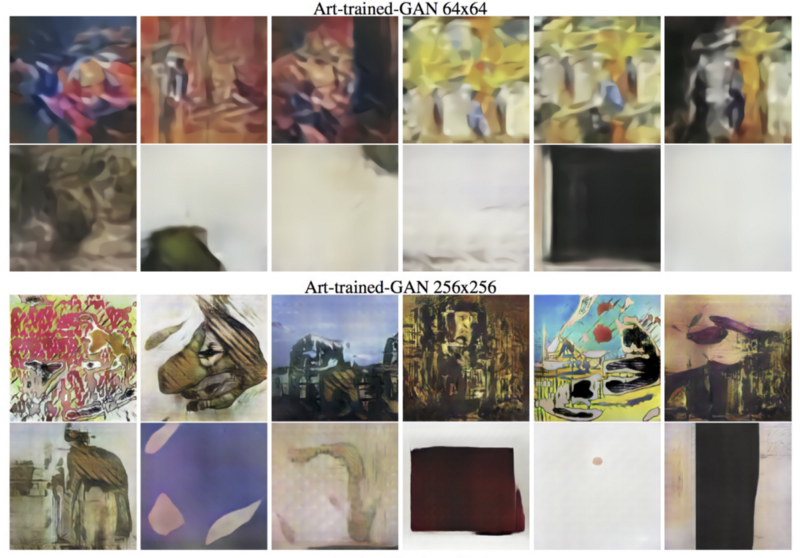
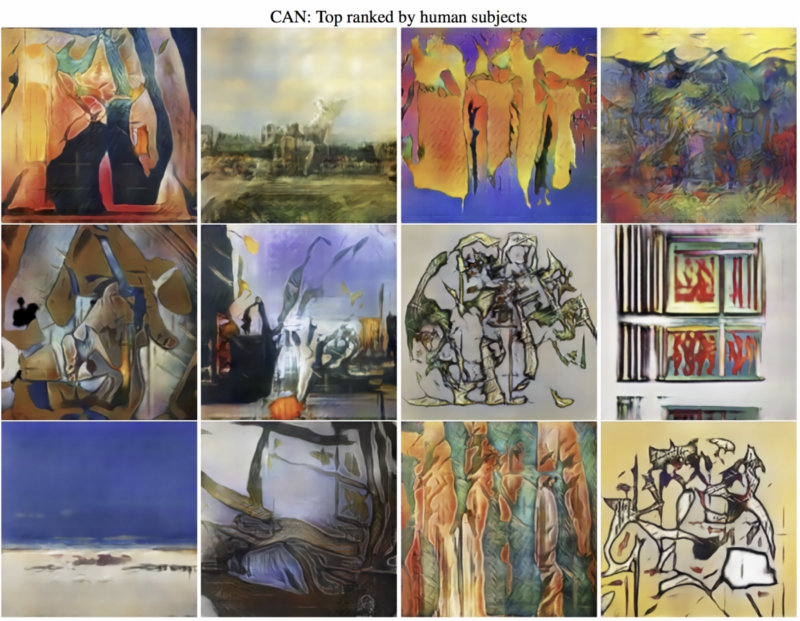
These models, trained on 81,449 paintings from 1,119 artists from the Fifteenth century to Twentieth century, were put to test. The above generated, novel images were created by GANs with increasingly complex network architectures. The top row consists of the most liked paintings and the bottom row consists of the least liked paintings as judged by humans.
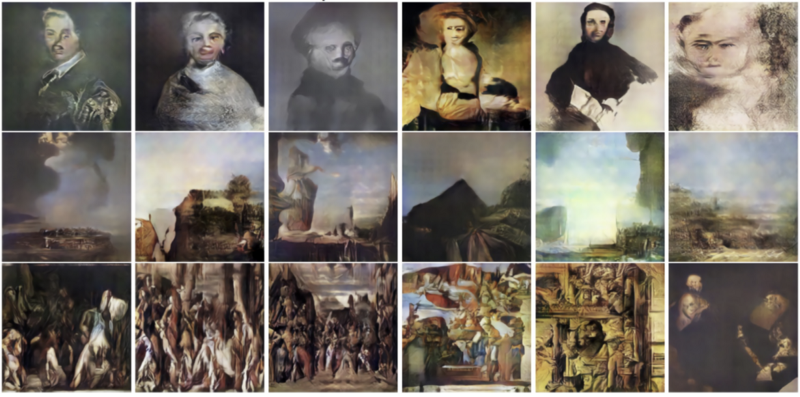
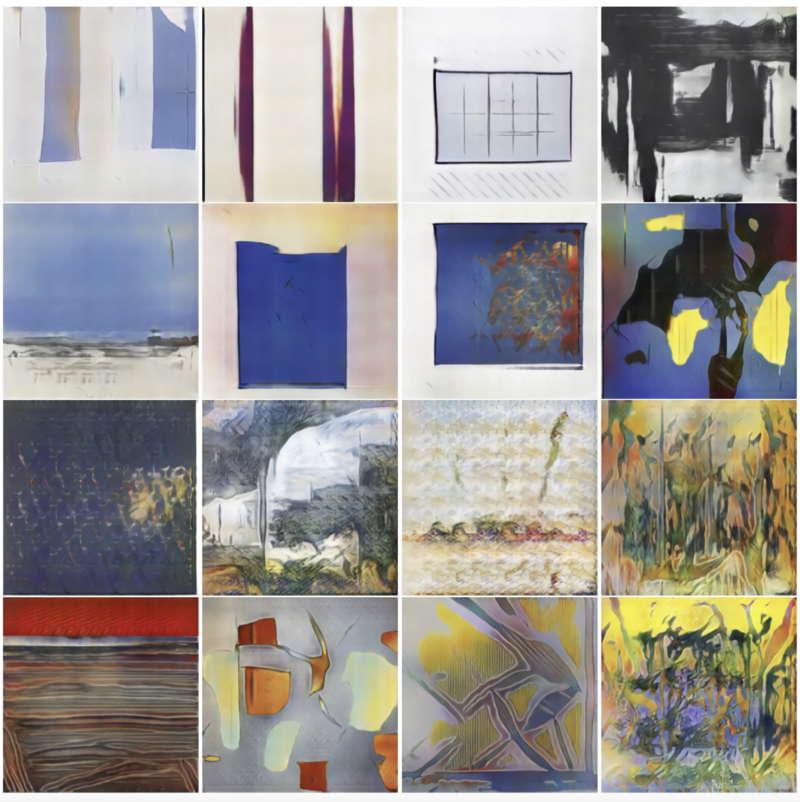
The above CAN implementation aims to calssify a generated image into a style and so takes into account a style classification loss leading to more style-conforming, less ambiguous works. To induce ambiguity, a style ambiguity loss is implemented in the proposed CAN model which generates aesthetically appealing images, as seen below, that can be characterized as novel and not emulating the art distribution.
Two sets of real paintings — Abstract Expressionist Set and Art Basel 2016 Set — are compared to the images generated by the AI networks. The former set is a collection of 25 paintings by Abstract Expressionist masters made between 1945–2007. The latter set consists of 25 paintings from the renowned art fair, Art Basel, in 2016.
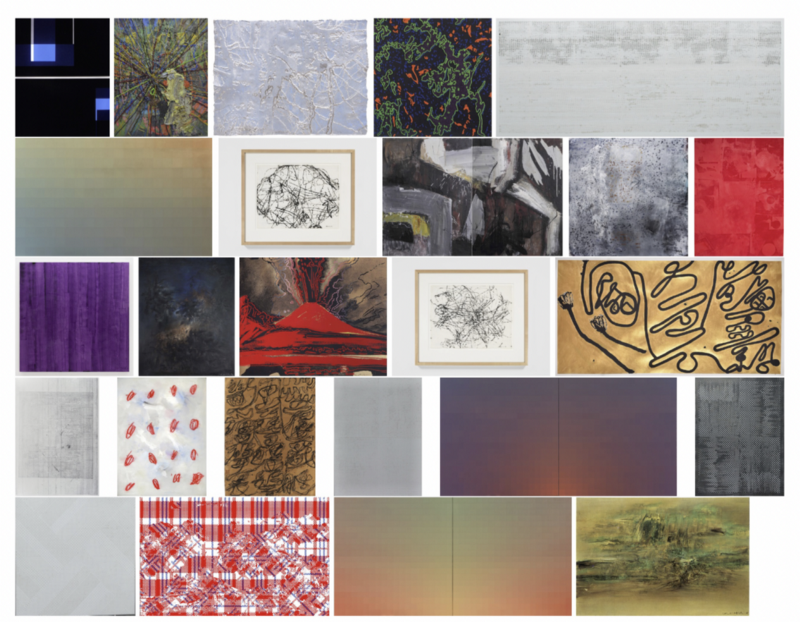
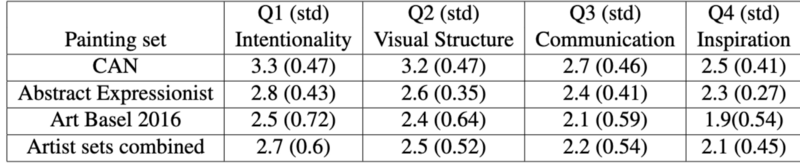
Not knowing the creator of the images, human subjects were asked if presented images were created by a human or a computer. 85% of Abstract Expressionist images, 53% of CAN images, 41% of Basel images, and 35% of GAN images were deemed human. In another experiment, humans were asked to rate the image sets on various parameters. The results are captured below.

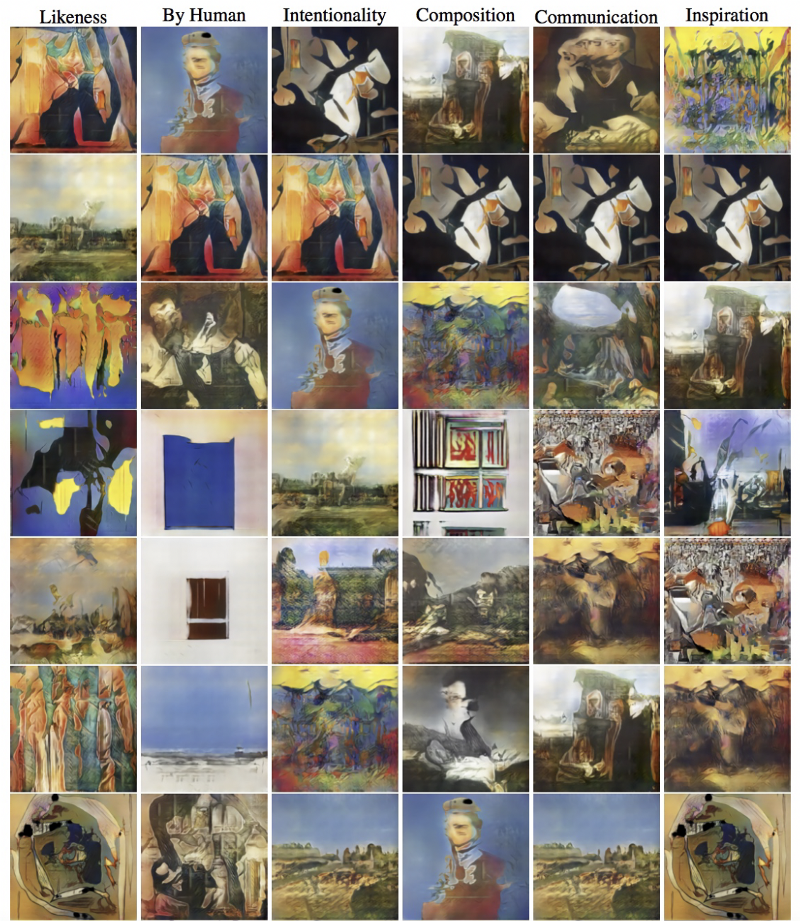
There is a weak correlation between the likeness rating and whether subjects think it is by an artist or a computer. The parameters above are rated sequentially from left to right leading to different results for the human/computer classification.
Then, the humans were asked to rate the pantings on more intangible yet intrinsic artistic parameters. The results below indicate that the CAN generated images were rated higher than human paintings in all aspects. So, the humans see these images as art.
When inquired about the novelty, 59.47% of the subjects selected CAN images as more novel and 60% of them found CAN images more aesthetically appealing. The highest ranked paintings created by CAN are displayed below with the ratings decreasing from top to bottom.
A main characteristic of the proposed system is that it learns about the history of art in its process to create art. However, it does not have any semantic understanding of subject matters, explicit models of elements, or principles of art. The learning here is based only on exposure to art and concepts of styles, which the system learns implicitly.