For Australian players looking for up-to-date platforms with fast withdrawals, it’s worth checking out the best new online casino sites Australia 2026 with real money pokies and PayID payouts. This guide breaks down the real terms offered by offshore operators, PayID transaction speeds, and how to tell a reliable platform from a mediocre one. It’s especially useful for anyone who wants to play for real money without waiting weeks for a payout.
Choosing the right deposit and withdrawal option can make or break your online casino experience, so it’s worth reviewing the best online casino payment methods for Aussies in 2026 before you sign up anywhere. This breakdown covers real processing speeds, hidden fees, and the offshore realities that Australian players need to understand. It’s a solid starting point for anyone who wants faster payouts and fewer surprises.
If you’re chasing bigger wins, it helps to know which titles actually deliver, so check out the best paying online pokies in Australia for 2026 before your next session. This guide highlights the machines with the highest RTP and most generous payout potential for Aussie players. It’s a handy reference for anyone who wants more value from every spin.
Before you commit to a new platform, it pays to compare what’s on the table, so start with this guide to the best welcome bonus online casino offers in Australia for 2026. It walks through sign-up promotions, wagering requirements, and the fine print most players overlook. A quick read here can mean the difference between a genuinely useful bonus and a wasted deposit.
For Aussie players who prefer a secure e-wallet over traditional banking, it’s worth exploring the casino sites that accept ecoPayz in Australia for 2026. This roundup covers platforms offering fast deposits, quick withdrawals, and solid bonuses for ecoPayz users. It’s a practical shortcut for anyone who values privacy and speed in their transactions.
Australian players who want to skip the guesswork can head straight to this guide to the best real money online casinos in Australia for 2026. It covers licensed offshore operators, banking options, and the key factors that separate trustworthy sites from risky ones. A useful read for anyone serious about playing for genuine cash rewards.
Prepaid payment options remain a popular choice for players who want to keep their banking details private, so it’s worth reviewing the casino sites that accept Paysafecard in Australia for 2026. This complete guide covers prepaid pokies, deposit limits, and how to cash out winnings from a voucher-based account. A handy resource for anyone who prefers top-up control over linking a card or bank account.
Players who value fast payouts and airtight security often turn to e-wallets, so it’s worth exploring the casino sites that accept Skrill in Australia for 2026. This guide breaks down e-wallet architecture, real payout speeds, and where to find genuine real money pokies. A smart starting point for anyone who wants deposits and withdrawals handled in minutes rather than days.
Finding a casino that supports your preferred banking method can save a lot of frustration later, so it’s worth checking out the casinos that accept MiFinity in Australia for 2026. This guide covers payment options, available pokies, and how withdrawals actually work for Aussie players. A practical read for anyone who wants a smooth, wallet-based casino experience.
Nobody likes waiting days for their winnings, so if speed matters to you, start with this guide to the best fast payout online casino in Australia for 2026. It compares withdrawal times across top platforms and highlights which ones actually pay out within hours. A must-read for players who want their cash without the usual delays.
PayID has quickly become one of the most convenient ways for Aussies to fund their casino accounts, so it’s worth reading this complete guide to new PayID pokies in Australia for 2026. It explains how to make fast, fee-free deposits and which platforms support the method properly. A great starting point for anyone who wants instant transfers without the usual banking headaches.
Getting your winnings quickly is one of the biggest priorities for any online player, so this complete pillar guide to a fast withdrawal casino in Australia for 2026 is well worth a look. It covers payout speeds, verification requirements, and the payment methods that actually deliver on their promises. An essential read for Aussies who don’t want to chase their cash for weeks.
If maximising your returns is the goal, it pays to know which platforms actually deliver, so dig into this definitive guide to the highest payout online casino in Australia for 2026. It breaks down real RTP figures, payout percentages, and how to spot operators that genuinely pay more. A valuable resource for players who want every dollar to work harder.
Not everyone wants to risk a large bankroll straight away, which is why this guide to a low deposit online casino in Australia for 2026 is worth a look. It covers small deposit options, PayID and crypto funding, and everything Aussies need to know before signing up. A smart read for players who want to start small without missing out on the fun.
Safety should always come first when real money is on the line, so it’s worth reviewing this breakdown of the most secure online casino in Australia for 2026. It covers technical safety audits, encryption standards, and the real money protocols that protect players. An essential read for anyone who wants peace of mind alongside their gameplay.
As life expectancy (LE) continues to increase, inequalities in life expectancy of people with disparate education levels will likely widen. The population-level LE is decreasingly informative as the average LE of sub-groups diverge.
Robust forecast and informed interpretation of LE must take cohort-specific characteristics and variances into account. The Lee-Carter model (Lee, Carter, 1992) is the most popular model for forecasting mortality rates and LE.
The model specified mortality rate as a function of three parameters– age-specific constraints, time-varying index, and interaction terms between time and age.
Noticing the drawback that applying this model separately for related populations, like neighbouring countries, leads to forecasts diverging significantly in the long-run, Li and Lee developed the Li-Lee model (Li, Lee, 2005).
The central idea behind the Li–Lee model is that related populations share a common time trend in the long run, but that there may be population-specific deviations in the short run. (Baal et al, 2016).
Baal et al built on the Li-Lee model by extending it to two subgroups–sex and education, and applying it to Dutch mortality and education level data from 1973-2012. The educational attainment segments were: low: primary education; middle: pre-vocational education; high: secondary and tertiary education.
In Baal’s model, there is a common time trend shared by all groups, a time trend shared by all educational classes within a sex, and a time trend for each educational class by sex leading to 9 total time-trend parameters.
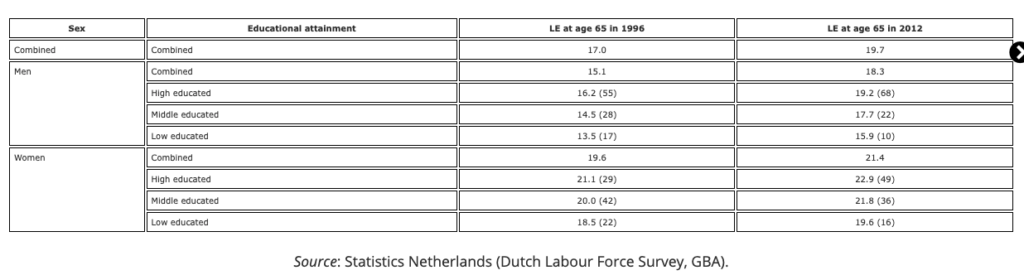
The model focuses on remaining LE at age 65. As seen in the table below, the LE at age 65 increased more for men than women between 1996 and 2012.
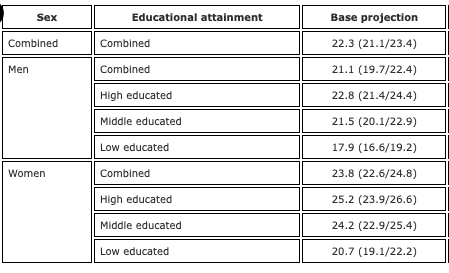
Below are Baal’s forecasts of LE in the Netherlands at age 65 in 2042 with the 95% prediction interval in parentheses.
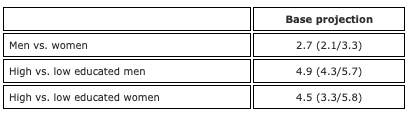
Below are the forecast differences in LE at age 65. Women are forecast an LE 2.7 years more than men. High educated men are forecast an LE 4.7 more than Low educated men. High educated women are forecast an LE 4.5 years more than low educated women.
Baal et al also visualise their forecast of LE and LE differences across cohorts in time-series plots as reproduced below. There is a wide variation in the cohort difference of predicted life expectancies.
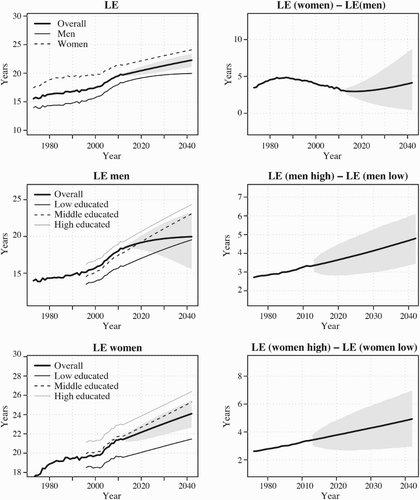
The results of our forecasts indicate diverging trends of mortality between the higher and lower educated subgroups, which are larger for men than women. (Baal et al, 2016)
This model isn’t without its drawbacks. It doesn’t take potential cohort-compositional changes into account. The age-time interactions are constant in the model unreflective of any changes that may occur in the future. The forecasting model also doesn’t consider any education-specific trends.
Despite a general improvement in medical treatments, large LE differentials across socioeconomic status groups have persisted, indicative of fundamental attributes that drive these differences.
Very informative article!