For Australian players looking for up-to-date platforms with fast withdrawals, it’s worth checking out the best new online casino sites Australia 2026 with real money pokies and PayID payouts. This guide breaks down the real terms offered by offshore operators, PayID transaction speeds, and how to tell a reliable platform from a mediocre one. It’s especially useful for anyone who wants to play for real money without waiting weeks for a payout.
Choosing the right deposit and withdrawal option can make or break your online casino experience, so it’s worth reviewing the best online casino payment methods for Aussies in 2026 before you sign up anywhere. This breakdown covers real processing speeds, hidden fees, and the offshore realities that Australian players need to understand. It’s a solid starting point for anyone who wants faster payouts and fewer surprises.
If you’re chasing bigger wins, it helps to know which titles actually deliver, so check out the best paying online pokies in Australia for 2026 before your next session. This guide highlights the machines with the highest RTP and most generous payout potential for Aussie players. It’s a handy reference for anyone who wants more value from every spin.
Before you commit to a new platform, it pays to compare what’s on the table, so start with this guide to the best welcome bonus online casino offers in Australia for 2026. It walks through sign-up promotions, wagering requirements, and the fine print most players overlook. A quick read here can mean the difference between a genuinely useful bonus and a wasted deposit.
For Aussie players who prefer a secure e-wallet over traditional banking, it’s worth exploring the casino sites that accept ecoPayz in Australia for 2026. This roundup covers platforms offering fast deposits, quick withdrawals, and solid bonuses for ecoPayz users. It’s a practical shortcut for anyone who values privacy and speed in their transactions.
Australian players who want to skip the guesswork can head straight to this guide to the best real money online casinos in Australia for 2026. It covers licensed offshore operators, banking options, and the key factors that separate trustworthy sites from risky ones. A useful read for anyone serious about playing for genuine cash rewards.
Prepaid payment options remain a popular choice for players who want to keep their banking details private, so it’s worth reviewing the casino sites that accept Paysafecard in Australia for 2026. This complete guide covers prepaid pokies, deposit limits, and how to cash out winnings from a voucher-based account. A handy resource for anyone who prefers top-up control over linking a card or bank account.
Players who value fast payouts and airtight security often turn to e-wallets, so it’s worth exploring the casino sites that accept Skrill in Australia for 2026. This guide breaks down e-wallet architecture, real payout speeds, and where to find genuine real money pokies. A smart starting point for anyone who wants deposits and withdrawals handled in minutes rather than days.
Finding a casino that supports your preferred banking method can save a lot of frustration later, so it’s worth checking out the casinos that accept MiFinity in Australia for 2026. This guide covers payment options, available pokies, and how withdrawals actually work for Aussie players. A practical read for anyone who wants a smooth, wallet-based casino experience.
Nobody likes waiting days for their winnings, so if speed matters to you, start with this guide to the best fast payout online casino in Australia for 2026. It compares withdrawal times across top platforms and highlights which ones actually pay out within hours. A must-read for players who want their cash without the usual delays.
PayID has quickly become one of the most convenient ways for Aussies to fund their casino accounts, so it’s worth reading this complete guide to new PayID pokies in Australia for 2026. It explains how to make fast, fee-free deposits and which platforms support the method properly. A great starting point for anyone who wants instant transfers without the usual banking headaches.
Getting your winnings quickly is one of the biggest priorities for any online player, so this complete pillar guide to a fast withdrawal casino in Australia for 2026 is well worth a look. It covers payout speeds, verification requirements, and the payment methods that actually deliver on their promises. An essential read for Aussies who don’t want to chase their cash for weeks.
If maximising your returns is the goal, it pays to know which platforms actually deliver, so dig into this definitive guide to the highest payout online casino in Australia for 2026. It breaks down real RTP figures, payout percentages, and how to spot operators that genuinely pay more. A valuable resource for players who want every dollar to work harder.
Not everyone wants to risk a large bankroll straight away, which is why this guide to a low deposit online casino in Australia for 2026 is worth a look. It covers small deposit options, PayID and crypto funding, and everything Aussies need to know before signing up. A smart read for players who want to start small without missing out on the fun.
Safety should always come first when real money is on the line, so it’s worth reviewing this breakdown of the most secure online casino in Australia for 2026. It covers technical safety audits, encryption standards, and the real money protocols that protect players. An essential read for anyone who wants peace of mind alongside their gameplay.
Brain-to-brain communication
Using non-invasive technologies, scientists constructed a proof-of-concept to communicate messages intercontinentally from a brain to another.
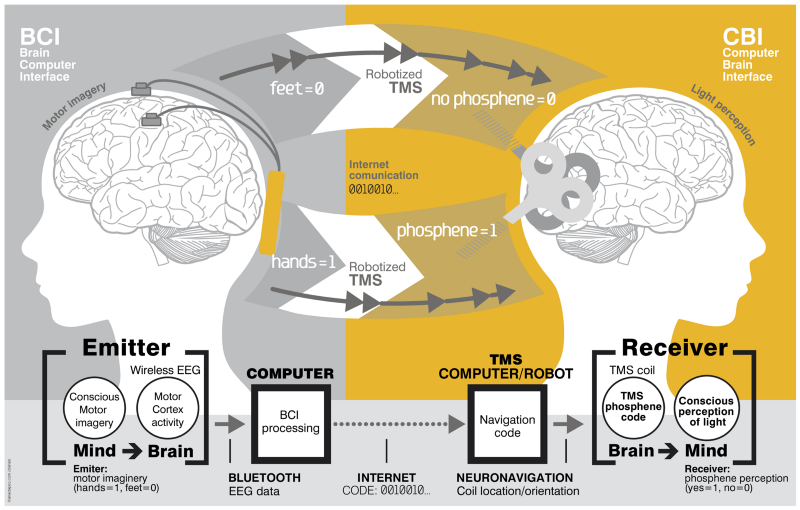
Scientists used Brain Computer Interfaces — EEG (Electroencephalography) and TMS (Transcranial magnetic stimulation) — to send a message from the mind of an emitter located in Thiruvanathapuram, India, to that of a receiver located in Strasbourg, France. EEG takes information from the emitter, and encodes and encrypts it. TMS, navigated by a robot, then conveys the decoded information in the form of short taps on the back of the head which may create a mild visual hallucination — a stimulated sensation of light called phosphene.
A scientist shows the emitter subject a representation of bits (numbers which are 0 or 1) in the form of a target cue on a screen. This cue object is located either in the down-right part of the screen (bit = 0) or in the upper-right part of the screen (bit = 1). If the object is located in the former section, the subject is asked to imagine movement of feet and if it’s in the upper-right section, the subject is asked to imagine movement of hands. Imagining moving hands encodes as 1 and imagining moving feet encodes as 0.
The EEG feeds on the representations of imaginations in the brain. There is a ball on the screen slowly moving rightward from the centre of the left side of the screen. Its vertical movement is controlled by the imagination. If the subject imagines movement of hands, the ball goes up, and if they imagine movement of legs, the ball goes down. Through repeated imagination, the emitter lands the ball in either the upper-right or the down-right section. This is done to ensure that the imagination of movement is encoded accurately.
This information is encoded, encrypted, and emailed to the lab in France. In France, the receiver subject receives stimulation from TMS. The coil in the machine that taps on the subject-specific occipital cortex part of the skull can either create visual sensations of light or not based on its orientation.
If the coil is in the active direction, the TMS-induced electrical field produces phosphenes in vision representing bit value 1. If the coil is placed orthogonally instead, the subject feels no visual stimulations. This represents bit value 0. The receiver can distinguish between the orientations only through the presence of phosphenes.
The subject reports verbally whether or not they perceived phosphenes on stimulation. These sensations have a strong, clear and reliable nature, and are located at the bottom of the visual field contralateral to the stimulation site. TMS pulses were administered by the robotized TMS system operated by an automated algorithm that parses the emails, decrypts the message, and delivers the stimulations. A researcher sitting out of sight of the subject supervises.
The transmitted message was a binary encoding of a word — “hola” in the first iteration of the experiment and “ciao” in the second. This message was encrypted using the 5-bit Bacon cipher, resulting in 20 bits. This was then replicated for redundancy 7 times resulting in 140 bits which were sent to the receiver. This is done such that neither the emitter nor the receiver can tell the message.
The combined error rate for both the brain interfaces was 4% in the second iteration of the experiment. The emission and reception rates of the transmission were of 3 and 2 bits per minute respectively, caused perhaps by the latency of the physical systems and the emphasis on robust preservation of the message.
As opposed to sending messages determined by the subjects, the messages determined by the experimenters are sent. So, the subjects aren’t consciously aware of the content of the message. As a proof-of-concept, this is more robust because it is more prone to error. If the emitter translated a personally chosen message to its binary bits and then sent brain representations of that, they would have more control over the accuracy of the transmission.
The proposed technology could be extended to support multidirectional communication between two or more minds. You could tell what number I am thinking of. In closed mind-loops, information associated with voluntary activity can be used to inform the more unconscious, subjective perceptions created in the brain. This could help regulate emotions, pleasure/pain, depression, obsessive-compulsive thoughts and more. Read the paper here.